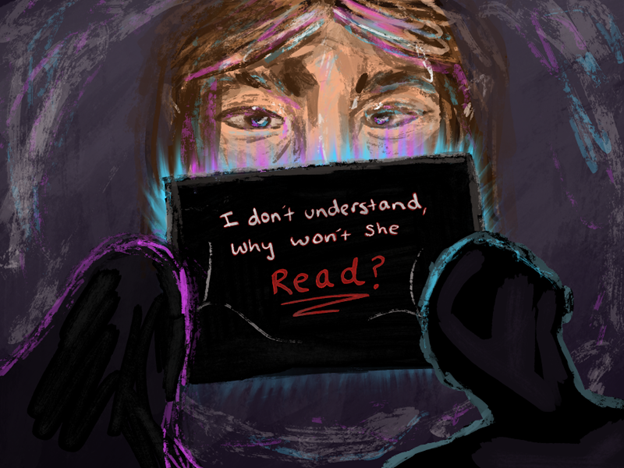
A teacher clears her throat, prompting twenty pairs of distracted eyes to flicker over her worn frame.
“Alright,” she chirps, clasping her hands and pasting on a friendly smile. “Today, you’re going to choose one of the four writing prompts I gave you on the handout yesterday and write a paragraph response. This should be five senten—” A collective groan resounds through the classroom, complaints erupting from the high schoolers.
“Five?”
“But I can’t—”
“Can we use AI—”
“—just do two?”
The teacher glares halfheartedly at her students, used to their behavior, but still wishing they did not find writing a mere five sentences such a laborious task. As she raises her voice to talk over them, she thinks back to what went wrong.
The Problem With Literacy (And Why It’s Not Just The Kids)
Whether you are a student, a teacher, a parent, or a circus clown named Bobbie, the dismal truth is clear: Children do not seem to know how to read or write, let alone want to. Oh well, just give them that handy-dandy iPad, and let YouTube occupy them. And sure, that may work, but is it productive? What new doors does it open up? More importantly, what doors does it close?
According to the Institute of Education Sciences, emergent literacy skills—vital foundations for cognitive growth—begin developing from birth. Concerningly, in a study of children ages 1 to 3, 90% had been exposed to TV or mobile devices, even though 60% had never been read to by a parent, suggesting that screen time often replaces literary interactions during crucial periods.
The root problem is that children are not being encouraged to read for fun, not really. However, this is not an individual failure, but a result of systemic and environmental factors that replace reading with faster, modern alternatives.
An academic study led by Alice Sullivan at CLS found that children who read specifically for pleasure demonstrate increased literacy skills and lexical development, with these benefits persisting into adulthood. Other researchers affirm the advantages of reading as a leisure activity, especially among children. With scientific evidence supporting the benefits, parents should prioritize reading as a pastime for their children. However, by the age of 2, 40% of toddlers already have their own tablet. This introduces children to digital entertainment instead of literacy, teaching them to shut off their brains rather than encouraging critical thinking, and exposing them to the overlooked danger that is short-form content.
T.T.W.H.B.L.B.T.Y.W.R.I.
(This Title Would Have Been Longer But Then You Wouldn’t Read it)
Children nowadays feel overwhelmed at the thought of writing five sentences, which is honestly not much. This disinterest stems from a lack of reading—higher reading rates correlate with stronger writing—and interaction with short-form content. Short-form content refers to any brief clip/video designed to capture the audience’s attention. Substituting reading with these videos causes a myriad of negative effects, including decreased sleep, heightened academic burnout, and poor mental health. Additionally, a meta-study of 98,299 people found a strong association between short-form videos and lowered cognitive ability.
Short-form content is specifically designed to be addictive, purposefully triggering dopamine releases in the brain through the ventral tegmental areas. Like an addiction, children can easily become hooked on short-form content, which weaponizes instant gratification, reward-based interaction, and dopamine deposits. It is a chemical imbalance, not a willpower issue, and certainly not something to blame on children. In contrast, reading requires longer attention spans, making it necessary to establish a foundational interest in reading during adolescence, despite the lure of easier, more addictive content.
What Did We Expect?
When a society is curated around the use of technology, children adapting their behaviors is not surprising. The sound of a classroom full of high schoolers groaning at the thought of writing five sentences is not a sign of laziness; it is an entirely predictable consequence of raising them in a doomed system of speed, reward, and stimulation. Children can still read and write, but they cannot see the words on the page over the glow of the tablet that was placed in front of them.
Works Cited
Alroqi, Haifa, et al. “The Association Between Screen Media Quantity, Content, and Context and Language Development.” Journal of Child Language, vol. 50, no. 5, June 2022, pp. 1155–83. https://doi.org/10.1017/s0305000922000265.
“Exploring the Science Behind Short Form Media’s Addicting Algorithm.” Columbia Science Review, www.thecolumbiasciencereview.com/online-articles/exploring-the-science-behind-short-form-medias-addicting-algorithm.
Horowitz‐Kraus, Tzipi, and John S. Hutton. “Brain Connectivity in Children Is Increased by the Time They Spend Reading Books and Decreased by the Length of Exposure to Screen‐based Media.” Acta Paediatrica, vol. 107, no. 4, Dec. 2017, pp. 685–93. https://doi.org/10.1111/apa.14176.
McArthur, Brae Anne, et al. “Longitudinal Associations Between Screen Use and Reading in Preschool-Aged Children.” PEDIATRICS, vol. 147, no. 6, May 2021, https://doi.org/10.1542/peds.2020-011429.
Regional Educational Laboratory Northwest. Montana ELA Standards Revision: Brief 3 Stages of Emergent Literacy and Language Development. Mar. 2024, ies.ed.gov/ncee/rel/regions/northwest/pdf/RELNW_MT-OPI-ELA_Brief-3_Stages-of-Emerg-Lit-and-Lang-Dev.pdf.
Riddle, Katia. “Tablets for Tots? Survey Says Kids Watch Videos on Their Own Devices by Age 2.” NPR, 26 Feb. 2025, www.npr.org/2025/02/26/nx-s1-5308593/children-screens-ai-common-sense-media.